


 Online


If you are teaching a subject such as history, science or maths, at primary or secondary level, this course will develop your skills in delivering that subject in English using the communicative method.
You’ll gain practical ideas you can use straight away in your classroom, and in-depth teaching strategies for planning and teaching successful CLIL lessons.
You may be working in a private language school, an international school, or a mainstream state school. Either way, this course is for you!
Price
The standard course fee is £325 including the certification. If you have completed a course with IH OTTI in the previous 12 months, we can apply the 10% loyalty discount, and the price for teachers working in an IH school is £276. We also have discounts for members of national or international teaching organisations, just let us know on your application form if you would like to claim these discounts.
Please note – 20% VAT will be added to the fee if it is paid by a business based in the UK, or the applicant is in the UK at the time of the course.
What is CLIL?
Content and Language Integrated Learning (CLIL) is when a school subject (maths, biology, geography, etc) is taught in a language that is different to the learners’ mother tongue. So learning objectives for each lesson are combined – primarily the subject, and secondarily English Language.
Many state schools and international schools look to recruit teachers who are skilled in CLIL, so they can help their students improve their English as well as mainstream curriculum subjects.
Is this Introduction to Teaching CLIL course for me?
Any teacher who uses English in a subject classroom can benefit from taking this course.
Teachers in primary or state schools, international schools, or language teachers helping subject teachers, will all benefit from this course.
Whilst many language teachers will be familiar with using another subject to enrich their teaching of particular vocabulary or grammar points, this course will go into more depth on the theoretical background.
This course is designed for you if you:
- Are currently teaching
- Have an English level of at least B1
- Have some experience teaching kids or teenagers
Is this course for me if …
… I teach large classes?
Yes. Large classes, with thirty or fifty students will always be a challenge to manage. This course will give you strategies to deal with their every day challenges. Producing language and achieving subject learning outcomes underpin all the techniques, whether they are pair work or small group work. Formative assessment strategies, specifically for large groups, are also covered.
… I have students with different levels of English?
Yes. CLIL teachers often find students who struggle in more traditional classes are more engaged and participate better in CLIL lessons because they are active. To help students with different language levels benefit linguistically, scaffolding is one of the most effective techniques. The course will cover practical ways to achieve this with examples from CLIL materials.
… I know a little bit about CLIL already?
Yes. Although the course is an introduction, it definitely goes into the theory behind the practice in detail (but not in a boring way, honestly!). So, teachers with some knowledge of CLIL will benefit from it. As far as possible, the theory and concepts presented in the course are explained using simple language to make them accessible to teachers of any subject.
… I teach in a government school with a set curriculum?
Yes. Each teaching context is unique, but the course offers a wide variety of options for teachers and even if you can’t use them all, there will certainly be at least some things you can use in your own classroom.
What is the content of the Introduction to Teaching CLIL course?
This is a blended course with both live and self-study (asynchronous) components. Your group will have a tutor to guide and help you, and there are discussion forums where you can exchange ideas with your fellow group members.
Each week starts with a live session of 90 minutes. This will be on a weekday, probably around 13:00 UK time, but will be agreed between the course participants at the time. Live sessions will also be recorded for those who cannot attend.The rest of the weekly material is online, ready for you to access in your own time when it suits you.
There are four modules in this course, one covered each week, each focusing on a different aspect of CLIL.
Module 1: Definitions and Theoretical Underpinnings
- Definitions and different models: soft and hard CLIL
- CLIL aims: dual focus on content and language
- Teacher competences: What does a CLIL teacher do?
- Theoretical underpinnings: The four Cs and the three Ds of CLIL
- What does CLIL look like in practice?
Module 2: Planning and Execution of a CLIL Lesson
- Defining learning objectives
- Task complexity and sequencing: from input to output
- Identifying academic language demands
- Scaffolding content, scaffolding language
Module 3: Materials
- Selecting CLIL materials
- Adapting materials for the CLIL classroom
- Creating CLIL materials
- Identifying cognitive and linguistic challenge: Cummins’ quadrants
Module 4: Assessment in the CLIL classroom
- Content, skills or language, what do we assess?
- Summative assessment: what makes a good exam question?
- Formative assessment: tips and techniques
- Backwards design
Applications
Please note online applications close on the Wednesday before the course starts. But we sometimes have late availability, so please get in touch with the admissions team on ihotti@ihworld.com and we will see if there are any last-minute spaces.
Duration
The duration of the course is 4 weeks, covering one module each week.
Your time commitment
The time commitment will vary depending on participant involvement in the online discussion forums, but as a minimum this should be three to five hours per week. Study hours are flexible but there will be tasks that require group input and have set deadlines. The more time and effort you put into the course, the more you will get out of it.
Your fellow course participants and online community
The number of course participants will be at least eight (that is our minimum).
The discussion forums that create an online community are what participants really value about this course. You can share best practice tips, exchange ideas, and discuss experience.
This course is not purely about self-study all on your own – it’s about making the most of these conversations and learning from each other as well as from the course material and your tutors.
Assessment
Your verified digital certificate
On successful completion of this course you will receive a digital certificate. This is stored securely on a verified site, so everybody can be confident that it is authentic and real.
It will look like the image below:
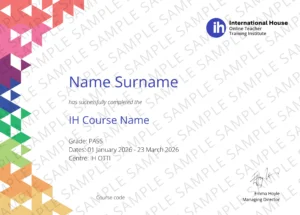
You can share this with a prospective employer, client, or anybody else that you choose.
A digital certificate is safer and more secure for you than paper – it won’t get lost in the post, it won’t get damaged over time, and won’t get lost. It is always available, you can share in just one click, or you can print as many copies as you like whenever you would like. And, it’s better for the environment. Reducing paper, ink, and delivery means a lower carbon footprint.
Click here for a short video about verified digital certificates from our partner Accredible.
Tutors
Your tutors will be experienced in using CLIL, and are qualified online teacher trainers. Meet our IH OTTI tutors here!








 Listening